Lowell Sumner
CITATION
Sumner Jr., EL (1947) Erosion in the Roaring River District, Kings Canyon National Park: a check-up after six years. Report to Sequoia and Kings Canyon National Parks. Photographed in Park archives, Three Rivers, CA.
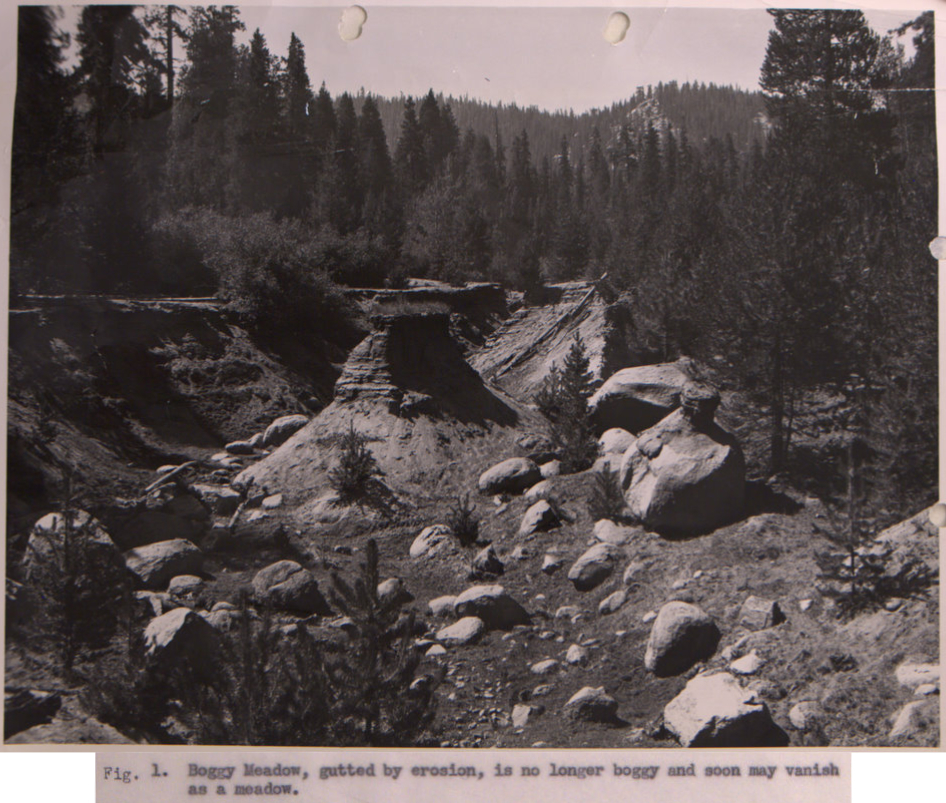
FIGURE 1
WRITTEN SUMMARY
Severe meadow erosion means a lot more than loss of wildlife habitat, or wounding of the esthetic sensibilities. Meadows in Sequoia-Kings with a normal life span of from several hundred to over a thousand years have, within a period of 40 years, been made centuries older by man-caused erosion. Some have been brought by erosion gullies to extreme old age and death.
This is a pictorial report for the benefit of those with limited time for reading. Thereby it avoids the bulk of the 1941 and 1942 reports that first described the destruction of these meadows. These earlier reports gave extensive background material that need not be repeated here. Most complete is “A Study of Conditions in the Roaring River District, Kings National Park, with Recommendations”, April 21, 1942, by District Ranger John E. Armstrong (177 pp., 232 figs.). Also useful is the “Special Report on Range Management and Wildlife Protection in Kings Canyon National Park”, May 23, 1941, by Regional Biologist Lowell Sumner (esp pp. 189-214).
Field studies summarized in the present report were made in the summer of 1947 during a six-week biological survey of Sequoia-Kings Canyon National Parks.
The mountain meadows are the heartlands of the Roaring River District, not only from the standpoint of beauty but of fertility, liveability and practical use of the area. Forty years of ruinous overgrazing have severely depleted the vitality of most of them and have advanced the date of their eventual extinction by centuries. A few are nearly extinct already.
In recent years the Park has secured some improvement in herding methods along the lines recommended in the above-mentioned reports. These improvements seem to have prevented the destruction noted in 1940 and 1941 from becoming a great deal worse by 1947. The expiration in a few years of one of the most seriously abused permits also will ease the situation to some extent, eventually. However, in certain of the meadows the damage is now too far advanced to be cured by improved herding methods alone. And to wait idly until a permit expires could be disastrous.
The water table must be restored, not only to meet the moisture requirements of meadow sod but also to halt further large-scale unnatural replacement of grass by lodgepole forest. The Park, always desperately short-handed, has been unable to undertake this soil and moisture conservation program although the need has been realized for several years. The 1947 drought has intensified the urgency by further weakening the remaining grass roots.
Soil and Moisture Conservation Funds are sorely needed to build check dams and fence the worst gullies.