Hot off the press: 20 years of research in Yellowstone

I started my professional ecological research with my Masters project in Yellowstone National Park more than two decades ago. During that project I helped establish the long-term research plots and data collection methods that led to this just-published summary of what happens when willows are protected from browsing and have extra water provided by simulated beaver dams.

As we hypothesized, the small streams in Yellowstone that used to support resident beaver for centuries, but lost them in the 1920s-1930s, have not seen a rapid recovery of willow just because wolves were reintroduced in the 1990s. Nor have the beavers returned in significant numbers. The impacted ecosystem, where streams eroded through the long-abandoned beaver dams and dried out conditions for willows, needs more than just reduced browsing pressure to recover.

Here’s a TikTok-er doing a good job summarizing our paper: https://www.tiktok.com/@natureexperienced/video/7331856319521017119

@natureexperienced

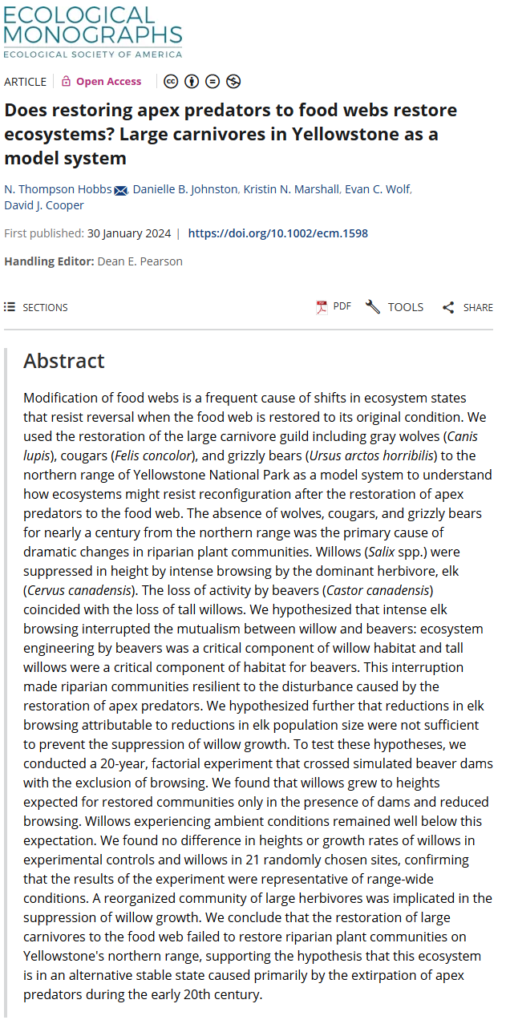
Read the paper! “Does restoring apex predators to food webs restore ecosystems? Large carnivores in Yellowstone as a model system” in Ecological Monographs. #Wolf #Yellowstone #Wildlife #Biology #Ecology #Science #Beavers #Nature #Research

♬ original sound – Nature Experienced

Click image below to go to free online paper:
Routes in California and Oregon… Report upon the zoology of the route, Castor canadensis

JS Newberry

CITATION

Newberry, JS (1857) Report upon the zoology of the route. In: HL Abbot, Reports of explorations and surveys to ascertain the most practicable and economical route for a railroad from the Mississippi River to the Pacific Ocean, v. 6: Routes in California and Oregon Explored by Lieut. R. S. Williamson, Corps of Topographical Engineers, and Lieut. Henry L. Abbot, Corps of Topographical Engineers, in 1855, part 4: Report upon the zoology of the route, ch. 1: Report upon the mammals, Castor canadensis, pp 58-59. War Department, Washington, D.C.

EXCERPT

“In California the beaver is also quite common, though less so than in Oregon. It is found in the streams flowing into the Sacramento, both from the coast range and from the Sierra Nevada. On Cottonwood creek, which comes down from the coast range, near Fort Reading, they abound, and have cut the cottonwood trees, which line the banks of the stream, of a diameter of from fifteen to eighteen inches….

The value of beaver skins has so much depreciated that they were offered to some of our party, by the bale, at twenty-five cents each.”