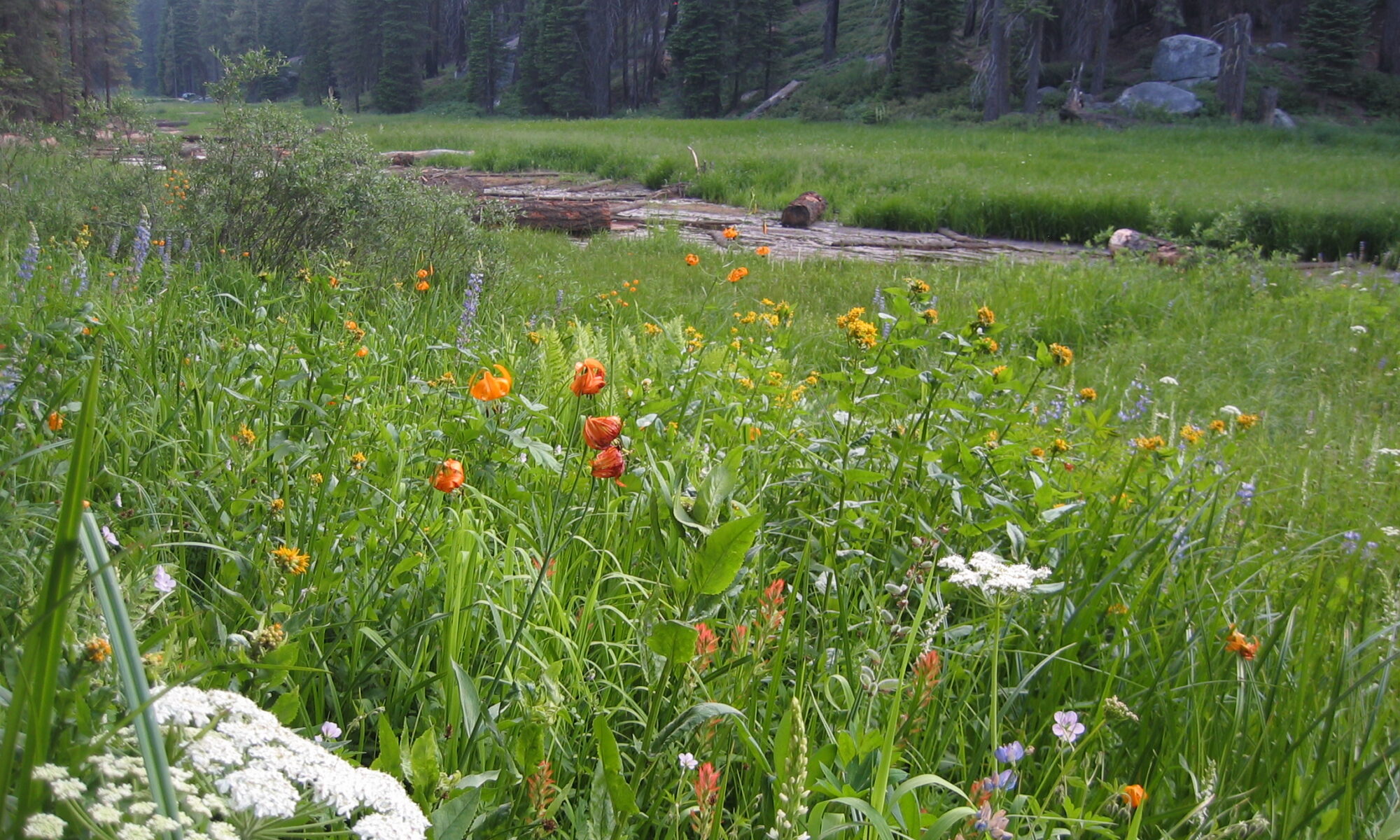
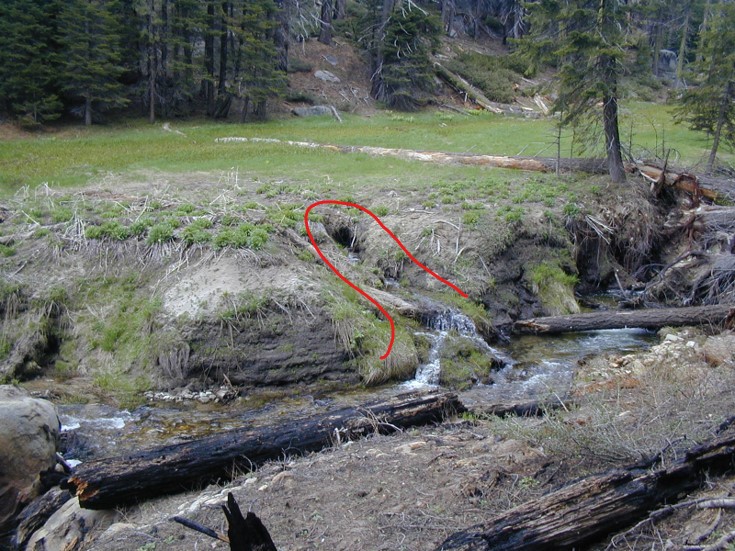
Charles Darwin was born 217 years ago today and he went on to develop the most important concept in biology and ecology: Evolution. I recently listened to a wonderful talk, sponsored by Bay Nature, about the evolution of a weird little animal that I’ve only seen once in the wild, the mountain beaver, Aplodontia rufa. These burrowing rodents live along the margins of Sierra Nevada wetlands and I’ve often seen their tunnels draining water from flooded areas to lower, drier erosion gullies.
Dr. Samantha Hopkins, paleontologist at the University of Oregon, described the fossil evidence for the 40 million year old lineage that has left A. rufa as the only living representative. Dr. Hopkins highlighted one of the odd things about modern mountain beavers: they have no loops of Henle in their kidneys. The loops allow for more concentrated urine and reuse of water. Without the loops, mountain beavers lose a lot of water in their urine and thus have a high water demand. Which is why they hang out near wetlands! Researchers have assumed that this lack of loops is a primitive trait, inherited from a long-extinct ancestor that the Aplodontia line shared with other rodents.
However, Dr. Hopkins’ lab is using isotopic analyses of fossil teeth to show that extinct ancestors probably did possess the ability to concentrate urine, and the lack of loops in modern mountain beavers is not an inherited “primitive” trait, but rather a more recently evolved one. Evolution works in weird and wonderful ways. The water-inefficient kidneys of the mountain beaver probably have some benefit for survival. At the very least, they keep the little animals close to some of the most beautiful places on earth!