Happy Darwin Day, 2026

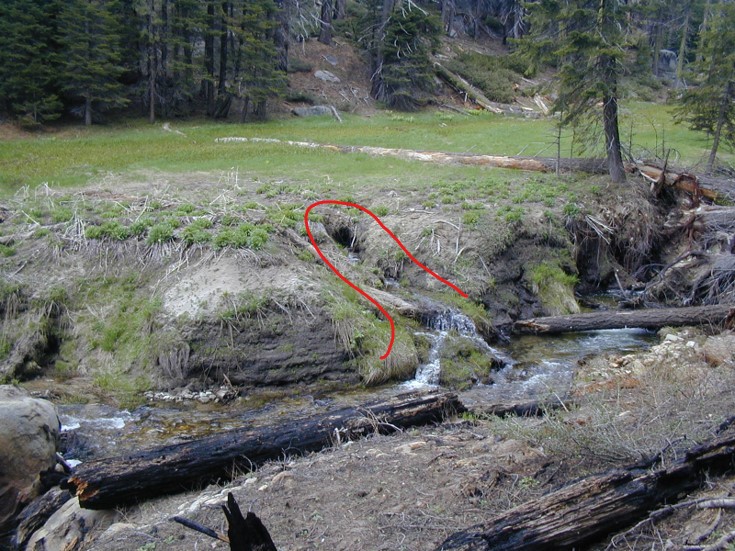
A mountain beaver burrow (outlined in red) draining Halstead Meadow into the former (now restored) erosion gully.

Charles Darwin was born 217 years ago today and he went on to develop the most important concept in biology and ecology: Evolution. I recently listened to a wonderful talk, sponsored by Bay Nature, about the evolution of a weird little animal that I’ve only seen once in the wild, the mountain beaver, Aplodontia rufa. These burrowing rodents live along the margins of Sierra Nevada wetlands and I’ve often seen their tunnels draining water from flooded areas to lower, drier erosion gullies.

Dr. Samantha Hopkins, paleontologist at the University of Oregon, described the fossil evidence for the 40 million year old lineage that has left A. rufa as the only living representative. Dr. Hopkins highlighted one of the odd things about modern mountain beavers: they have no loops of Henle in their kidneys. The loops allow for more concentrated urine and reuse of water. Without the loops, mountain beavers lose a lot of water in their urine and thus have a high water demand. Which is why they hang out near wetlands! Researchers have assumed that this lack of loops is a primitive trait, inherited from a long-extinct ancestor that the Aplodontia line shared with other rodents.

However, Dr. Hopkins’ lab is using isotopic analyses of fossil teeth to show that extinct ancestors probably did possess the ability to concentrate urine, and the lack of loops in modern mountain beavers is not an inherited “primitive” trait, but rather a more recently evolved one. Evolution works in weird and wonderful ways. The water-inefficient kidneys of the mountain beaver probably have some benefit for survival. At the very least, they keep the little animals close to some of the most beautiful places on earth!

World Wetlands Day 2026

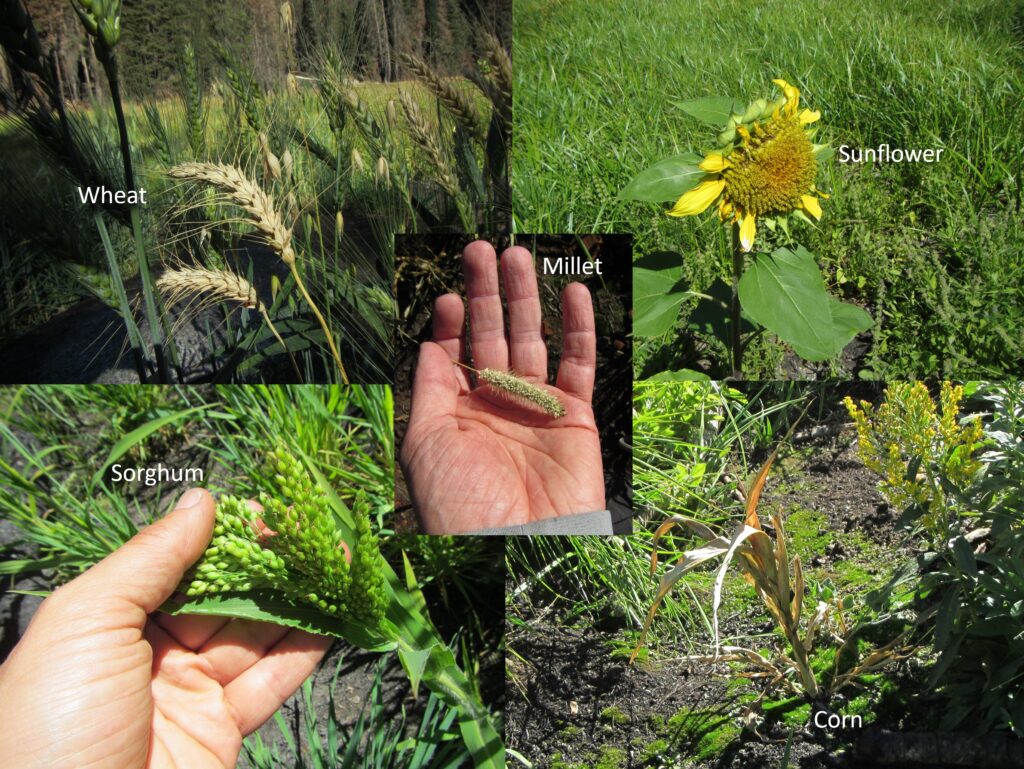
Five crop plants that grew in Halstead Meadow during the summer of 2022, in patches burned in the 2021 KNP Complex fire.

Wetlands are wonderful places, as people have known for thousands of years. Their rich soil and abundant water make for excellent crop land, usually once some of the abundance of water has been drained away. At Halstead Meadow, a wetland in Sequoia National Park, a group of crop plants sprouted out from the ashes in patches burned in the 2021 KNP Complex wildfire. These agricultural plants – wheat, sunflower, millet, sorghum, and corn – grew only in the summer of 2022, and only in areas where the KNP fire had burned away the top 4-6 inches of organic wetland soil. The seeds had probably been lying dormant, buried under wetland soil, since they were planted over a century ago before Sequoia National Park existed. Back then a cattleman named Sam Halstead had used this meadow for grazing, and apparently for growing a few crops! I collected leaf and seed samples from each of these plants and they’re sitting in my freezer. I’m hoping to find a expert in crop varieties who would be willing to analyze the genetics of these plants to see if they belong to old crop lineages. Wetlands preserve a wealth of fascinating stories.

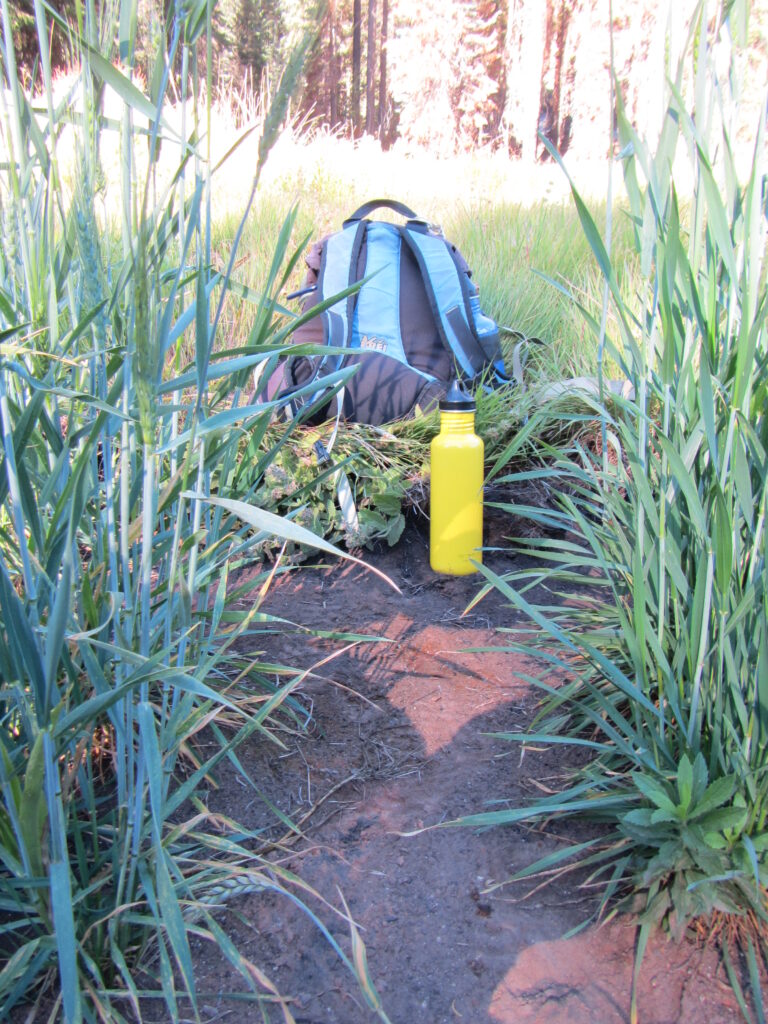
Four to six inches of soil depth were burned away in 2021. In 2022, when this picture was taken, crops such as the wheat seen here in the foreground were found growing out of the exposed soil layer within the burned patches.

Restore wetlands to improve grazing lands

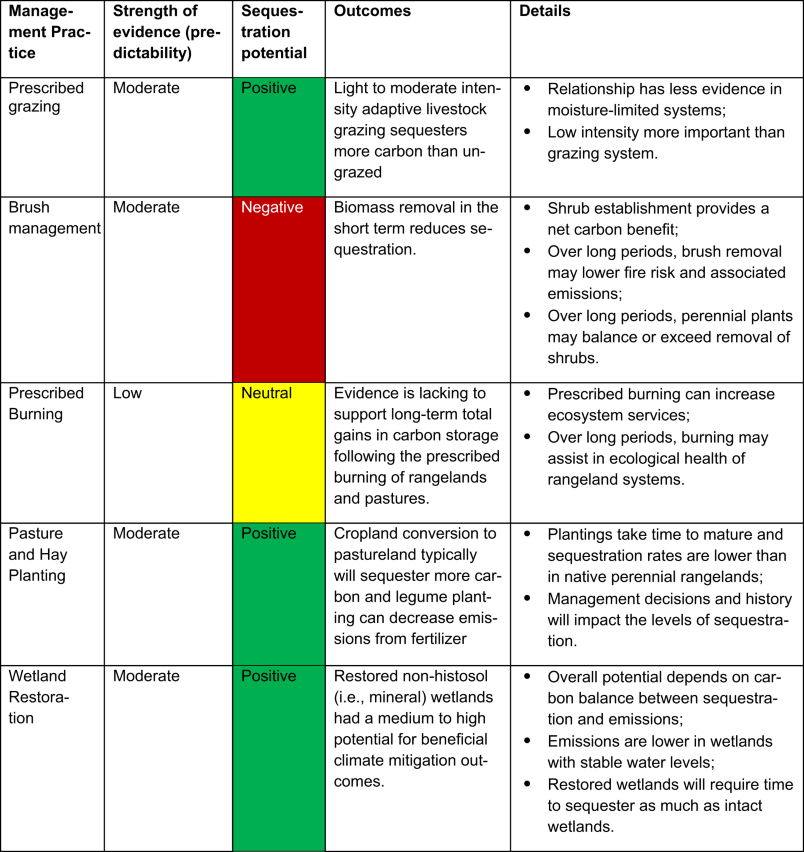
A recent review of research into how best to enhance carbon storage on grazed lands in the US identified wetland restoration as one of the most effective practices. Almost all of the wetland research and restoration projects that I have worked on were impacted by grazing, so the broad findings from this paper correspond well to my focused experience.

“…there is strong evidence to support that wetland restoration can be an effective climate mitigation strategy for sequestering SOC [soil organic carbon] and restored wetland systems can have similar GHG [greenhouse gas] emissions to pre-established wetland systems.”

John Muir in Evolution Valley

I’ve recently returned from an amazing trip to Evolution Valley in Kings Canyon National Park where I’m working with the Park and the John Muir Trail Wilderness Conservancy to restore impacted wilderness wetlands. During my research into the earliest descriptions of the valley, I’ve determined that the first written account of Evolution Valley (unnamed at the time) was by John Muir himself.

Early landscape descriptions are extremely valuable when assessing ecosystem function because they give a sense for how much, or little, a place may have changed through time and due to human impacts.

Theodore Solomons, who named the Evolution group of peaks in 1895 and who conceived of and planned what would become the John Muir Trail, is often credited with writing the first description of the area. Solomons (1896), Mt. Goddard and its vicinity – in the high Sierra of California. Appalachia 8:41–57.

However, John Muir was there 22 years earlier, and I’m not the first to note that Muir almost certainly walked through Evolution Valley during his 1873 trip up the San Joaquin River.

In 1925 Francis Farquhar wrote, in Exploration of the Sierra Nevada (page 28):

“In 1873 Muir… set out on a solitary journey for a few days and climbed the highest mountain at the head of the San Joaquin, which he supposed was the one named by the Whitney Survey Mount Humphreys. His description, however, clearly indicates that he was on one of the mountains a little farther south, probably Mount Darwin”.

Mount Darwin, as the name implies, sits atop the head of Evolution Valley.

Construction of the John Muir Trail, which runs through Evolution Valley, began in 1915, a year after Muir’s death. The trail is a wonderful tribute to him, and I think it’s fitting to discover that John Muir was the first person to write about one of the most spectacular sections of the trail in his typically exuberant voice.

Here is John Muir’s description of Evolution Valley [with my notes in brackets], from The Mountains of California (1894), chapter 14, pages 308-312:

“In the fall of 1873 I was tracing the South Fork of the San Joaquin up its wild cañon to its farthest glacier fountains… On my way over the glacier-polished rocks along the river, I came to an expanded portion of the cañon, about two miles long and half a mile wide, which formed a level park inclosed with picturesque granite walls like those of Yosemite Valley… I lay down to sleep on a smooth place among the yellow leaves of an aspen grove… [The Blayney Meadow area at 7640 ft best matches this description: it is 1.8 miles long, 0.4 miles wide at its widest, contains an uncommonly large aspen grove, and its lower end is an abrupt transition from confined stream channel canyon (downstream) to broad meadow with tall flanking cliffs (upstream). Neither of the other two possible locations, Jackass Meadow at 7180 ft or Aspen Meadow at 8200 ft, match his description as well.]

Next day I discovered yet grander landscapes… Following the river over huge, swelling rock-bosses through a majestic cañon, and past innumerable cascades, the scenery in general became gradually wilder and more alpine. The Sugar Pine [Pinus lambertiana, 3900-8600 ft] and Silver Firs [Abies concolor, 4200-10800 ft] gave place to the hardier Cedar [Juniperus grandis, 5900-10200 ft] and Hemlock Spruce [Tsuga mertensiana, 8800-10900 ft]. The cañon walls became more jagged and bare… [This description matches well with Goddard Canyon, whose floor is at ~8300 ft and rim at ~10300 ft] …

Towards the middle of the afternoon I came to another valley, strikingly wild and original in all its features, and perhaps never before touched by human foot [my emphasis]. As regards area of level bottom-land, it is one of the very smallest of the Yosemite type, but its walls are sublime, rising to a height of from 2,000 to 4,000 feet above the river. At the head of the valley the main cañon forks, as is found to be the case in all yosemites. The formation of this one is due chiefly to the action of two great glaciers, whose fountains lay to the eastward, on the flanks of Mounts Humphreys and Emerson and a cluster of nameless peaks farther south. [This is probably Evolution Valley, 9200-9900 ft; from Blayney Meadows about 9 miles to the valley mouth and 15 miles to the valley head, reasonable distances for Muir to have traveled by mid-afternoon and evening, respectively].

The gray, boulder-chafed river was singing loudly through the valley, but above its massy roar I heard the booming of a waterfall, which drew me eagerly on; and just as I emerged from the tangled groves and brier-thickets at the head of the valley, the main fork of the river came in sight, falling fresh from its glacier fountains in a snowy cascade, between granite walls 2000 feet high. The steep incline down which the glad waters thundered seem to bar all farther progress.”

The falls that Muir describes match well to those at the head of Evolution Valley. They are the only significant perennial falls near the head of any of the South Fork San Joaquin river tributaries. The other major glacial valleys of Goddard Canyon, Piute Canyon, and French Canyon all climb gradually to broad lake-filled cirques with no cascades at their head. In addition, Muir’s assessment of the headwaters being east of the valley head and at or south of Mt. Humphreys and Mt. Emerson would further suggests he was in one of the two parallel west-east trending valleys: Piute or Evolution Valley. The headwaters of north-south trending French Canyon lie distinctly north of the valley head and north of Mt. Humpheys and Mt. Emerson. Similarly, Goddard Canyon trends north-south and its headwaters are to the south of the valley and lie far south of Mt. Humphreys and Mt. Emerson.

The head of Piute Canyon is a vast open lake-dotted upland called the Humphreys Basin that drains Mount Humphreys and Emerson to the east. However, the broad open basin contains no cascades or steep valley walls, and in no other way matches Muir’s description. Nor do any of the small cirque-lake-headed valleys that line the south side of Piute Canyon and the Humphreys Basin along the Glacier Divide. The headwaters of Evolution Valley lie to the east of the valley head and could reasonably be mistaken to include drainage from Mount Humphreys and Emerson to the north, and definitely do include drainage from at-the-time-nameless peaks to the south of those two mountains.  In addition, Evolution Valley is the only location with a large perennial waterfall at a steep valley head that branches as two distinct glacial paths. The glacial valley branch may refer to either McGee Canyon, a large glacial valley tributary to Evolution Valley or the branching may refer to the very head of Evolution Valley where two small hanging or stepped valleys converge: one north towards Evolution Lake and the Darwin Bench, and one to the east containing a small unnamed basin perched above Evolution Valley. The cascade of Evolution Creek falls down the cliff between these two elevated valleys.

This comparison of the regional geography to Muir’s description makes it clear that he was in fact writing the first account of Evolution Valley in 1873. As mentioned earlier, Francis Farquhar came to a similar conclusion in 1925, as did James G Moore in his excellent book “Exploring the Highest Sierra” (pages 71-75). It should also be noted that an anonymous Google Earth Community member known as “spacecowboy2006” posted Muir’s description under the heading “Muir in Evolution Valley” on 2009July12.

Read my 2021 Evolution Valley report
Tioga Road opening predicted June 4th, 2025

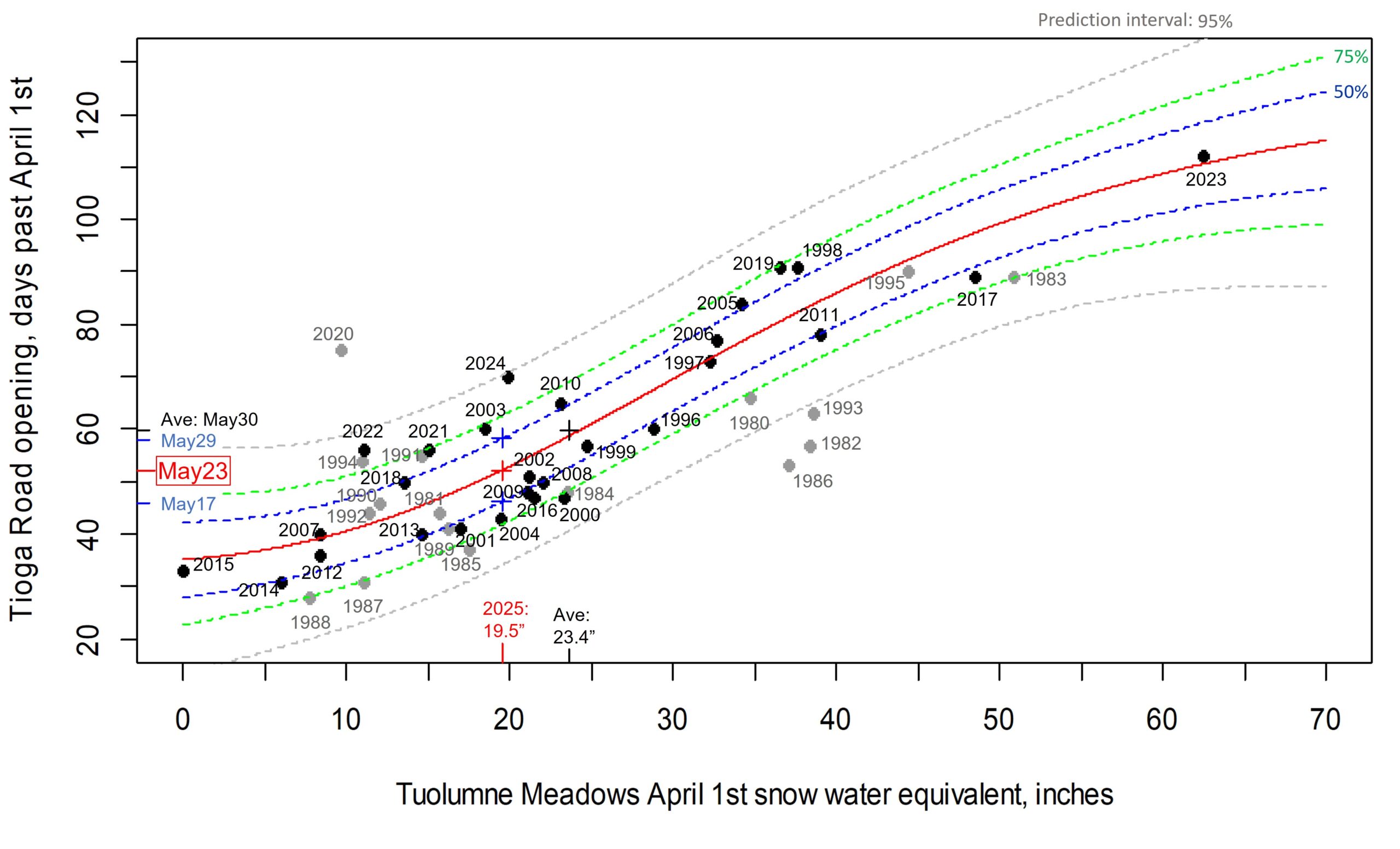
Spring is back, the snow is melting, and I’m thinking of the mountains waking up after a long cold winter. The April 1st snowpack at Tuolumne Meadows was pretty close to average for the second year in a row. The winter rangers measured 19.5 inches of snow-water-equivalent at the Tuolumne snow course at the end of March. So, once again I’ll use the past measurements of April 1st snowpack and the corresponding year’s Tioga Pass Road opening date to try and predict this year’s road opening based on current snowpack. This simple model predicts the road should open on May 23rd this year, with a 50% chance that the actual opening date will fall between May 17th and May 29th.

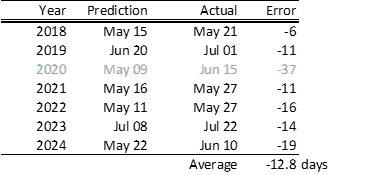
Looking back at how well this model has performed over the past 7 years is indicative of how a single measurement of snowpack doesn’t capture all the factors that go into the complex operation of clearing a high mountain road for public access. The closest I’ve been was 6 days off in 2018, my first prediction year. The furthest off was during the first wave of covid in 2020 when I missed by 37 days. Last year was second worst, off by 19 days.

Interestingly, in each of the past 7 years the actual opening day always has been later than I’ve predicted, never earlier. This could just be chance, or it could indicate that plowing and prepping the road takes longer now than it did in the past, for reasons unrelated to the amount of snow. Excluding 2020, the Tioga Road has opened an average of 13 days later than my prediction.

So let’s just add that correction to the snow-only model prediction of May 23rd and guess that the road will actually open on June 4th, with a 50% interval from May 29th to June 10th.

*Note that the model changes every year to incorporate the newest data, so the current graph does not match up with previous years’ predictions. This is most apparent for 2023. Before that data point was established, the right side of the graph was empty. Now that we have some data there, the model can match it better.

Find raw data here: https://www.nps.gov/yose/planyourvisit/seasonal.htm and here: https://cdec.water.ca.gov/reportapp/javareports?name=COURSES

The people who protect and restore our public land

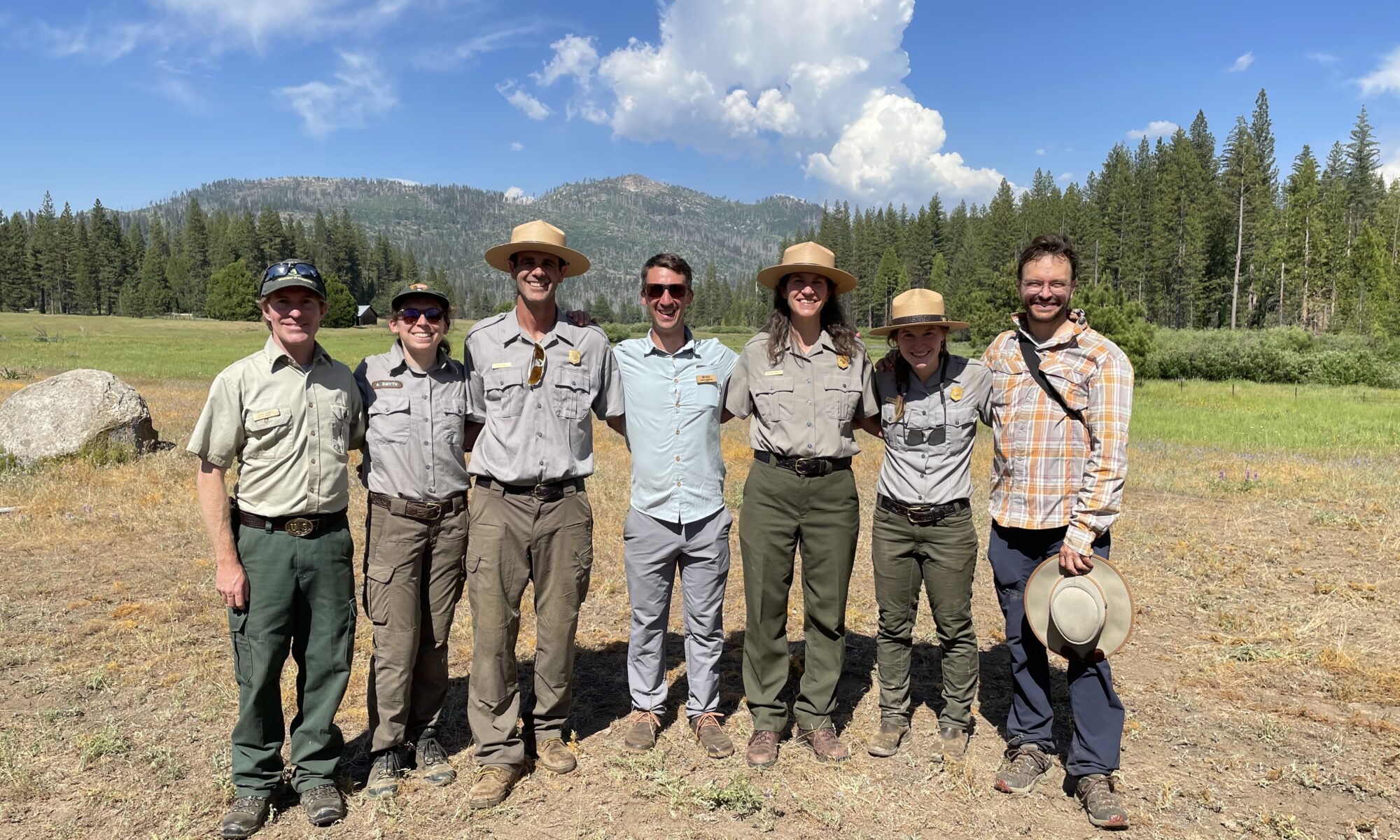
Our National Parks and Forests can’t protect themselves. It takes a team of skilled and dedicated workers, most of whom are federal employees, to keep these lands unspoiled and accessible for you and me. We inherited this fortune, and it’s our responsibility to ensure that we don’t trash these treasures, and to maybe even improve them a bit as a gift to the next generation of lucky Americans. From left, Curtis Kvamme, Stanislaus National Forest; Allison (Slim) Smyth, Yosemite National Park; Tim Kuhn, Yosemite National Park, Matt Freitas, American Rivers; Athena Demetry, Yosemite National Park; Mel Steller, Yosemite Naitonal Park; me.

World Wetlands Day 2025

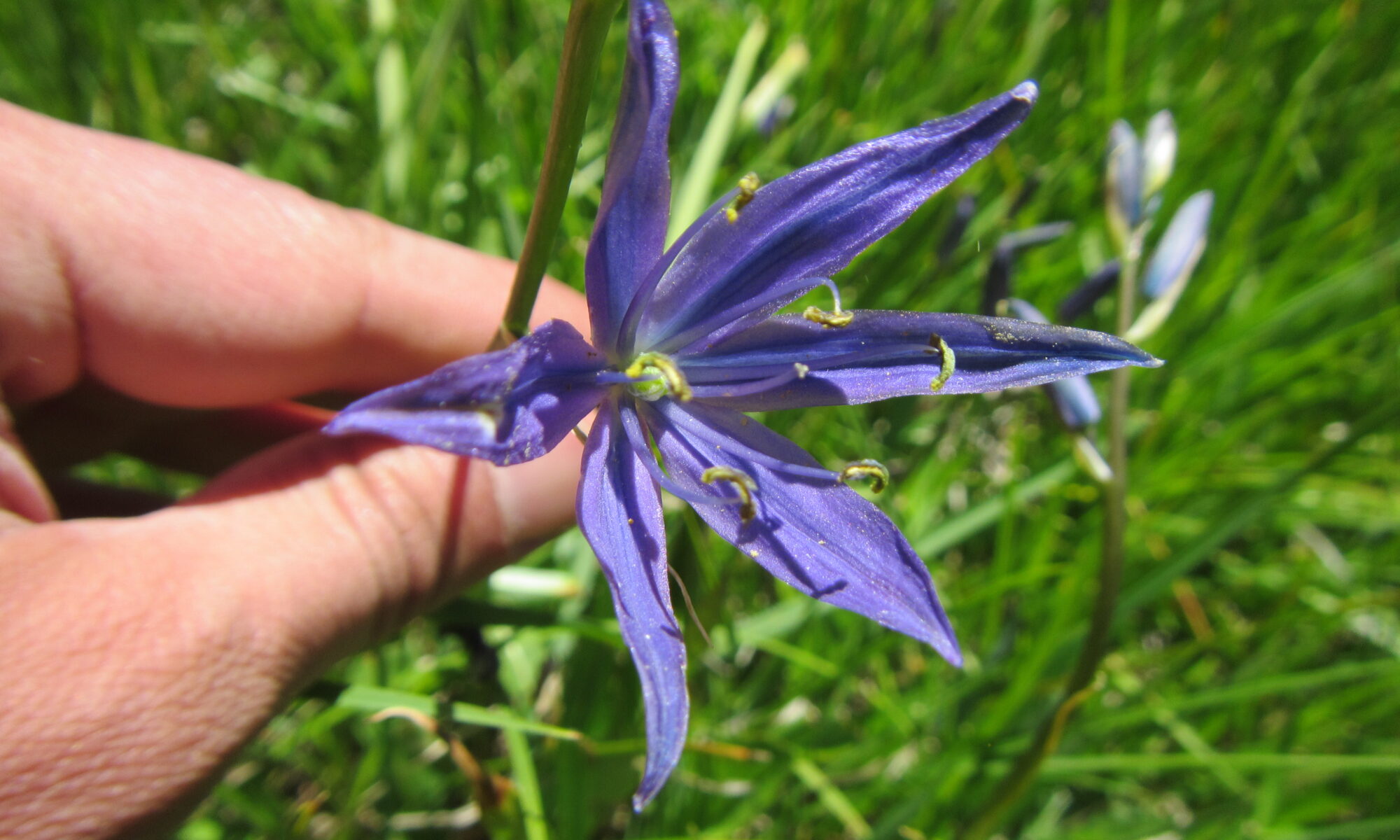
Introducing camas lily (Camassia quamash), a lovely purple-flowered bulb that grows in wetlands throughout the western US. Individuals can live 15-20 years, and won’t flower until they’re 3 or 4 years old. Native Americans, especially in the Pacific Northwest, consumed the bulbs as a major part of their diet. They fed camas bulbs to Lewis and Clark’s starving exploration party as they moved across what is now western Montana, Idaho, and eastern Washington. This summer I’ll be starting a project at Weippe Prairie, part of the Lewis & Clark National Historic Trail and Nez Perce National Historical Park. Our main goal will be to reestablish the wetland and ecological conditions to create dense patches of camas lily. Prior to large-scale agriculture, camas covered entire wetland valleys for miles. On June 12, 1806 the Lewis and Clark expedition passed through Weippe Prairie on their return home and marveled that “the quawmash is now in blume and from the colour of its bloom at a short distance it resembles lakes of fine clear water, so complete is this deseption that on first sight I could have swoarn it was water.”

Widespread Losses of Birds in All Habitats–Except for One… Wetlands

https://www.stateofthebirds.org/2022/

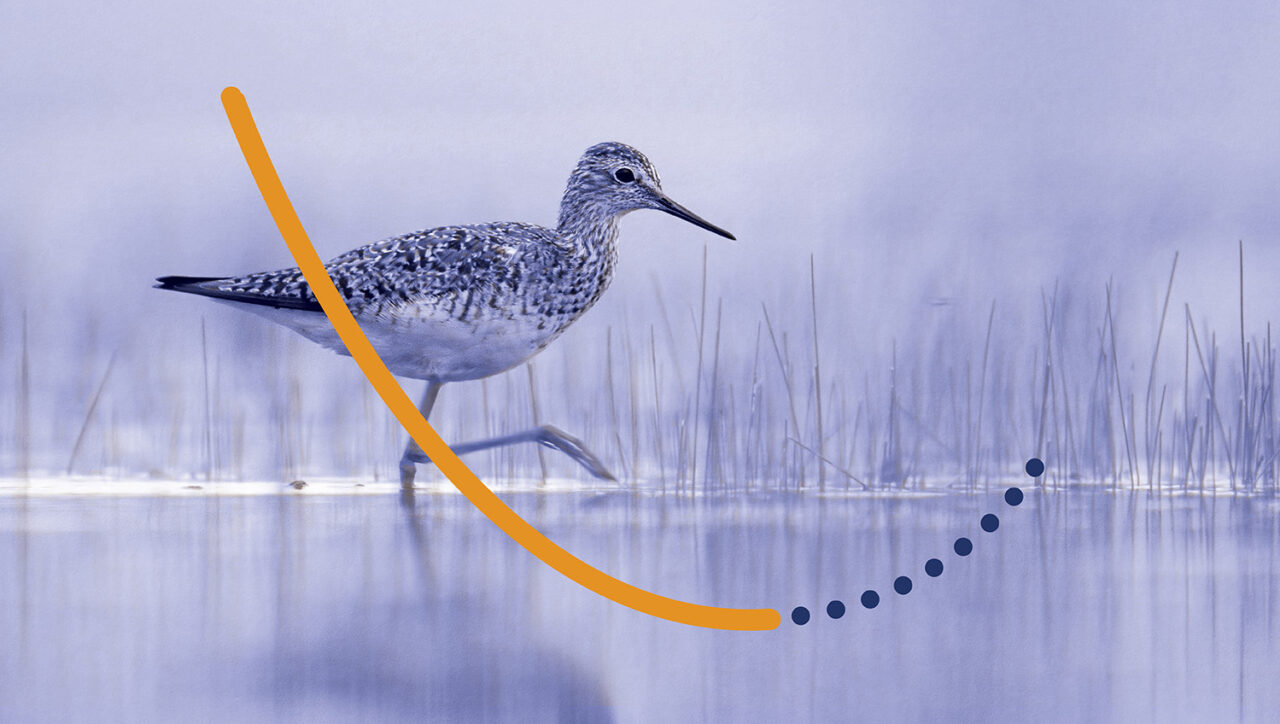
The 2022 State of the Birds report (the most recent available) describes how investment in conservation and restoration of wetlands has led to critical gains in wetland-dependent bird species. This is an important and singular ray of sunshine in an otherwise gloomy report detailing the broad decline of birds across the US.

“The trends for our nation’s birds reveal a vital message. Birds are declining overall in every habitat except in wetlands, where decades of investment have resulted in dramatic gains. Conservation works when we give birds and nature a chance. Let’s do more to save our nation’s birds and benefit people in every state.”